

- Home
- Kilas Global
- From Physics to Factory: NAED's PV-1 Delivers the Tandem Era at 96,000 WPH
Selasa, 17 November 2026 07:13:00
From Physics to Factory: NAED's PV-1 Delivers the Tandem Era at 96,000 WPH
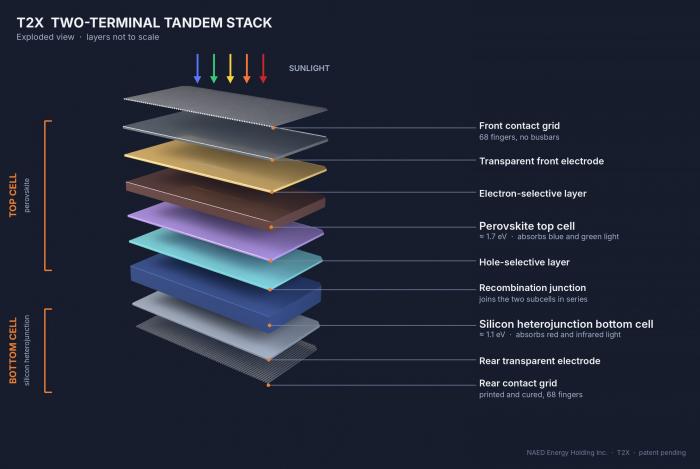
# | Station | Function |
1 | Wet bench (Qyrion 1000) | Cleans and textures the silicon wafers |
2 | V-Loader (VL-1) | Loads wafers edge-on into twin vertical carriers |
3 | Load lock (LL) | Takes the carriers from atmosphere into vacuum |
4 | Process module PM1 | PECVD-V deposition, front face |
5 | Transfer module TM1 | Moves carriers between process modules under vacuum |
6 | Process module PM2 | PECVD-V deposition, front face |
7 | Carrier rotation station (CRM-ST) | The 180? whole-carrier turn, in vacuum |
8 | Process module PM3 | PECVD-V deposition, rear face |
9 | Transfer module TM2 | Vacuum transfer |
10 | Process module PM4 | PECVD-V deposition, rear face |
11 | Unload lock (UL) | Returns the carriers to atmosphere |
12 | Unloader (UN-1) | Transfers wafers to trays without contact |
13 | In-line PVD (ITO-1) | Transparent conductive and interconnect layers |
14 | Rear print and cure (RP-1) | Prints and cures the rear contact grid |
Ten doors per line isolate the vacuum stations: two atmospheric lock doors and eight slit valves, each interlocked so that a door opens only when both sides are matched.
The Engineering Record
Every machine on the line is engineered to build level, and the whole line is documented at print level on large-format 36 ? 24 in sheets. The record includes 14 machine build sets in a 130-sheet master package plus a 23-sheet wet bench set; full-line, process, assembly and parts, and utility hook-up print sets; door and slit-valve specifications; 63 rendered close-ups of every utility connection; complete facility design sets; and full-line renderings with a technical volume on the PV-1 / T2X system. The eight large-format print sets alone run to 102 sheets.
The Complete Bill of Materials
The complete parts list holds 709 part numbers across the wet bench and the 13 PV-1 machines, numbered without gaps and totalled by formula.
Total | Value |
Part numbers | 709 |
Hardware pieces per PV-1 line | 2,807 |
Hardware pieces, six lines | 16,842 |
Utility hook-up components per line | 711 |
Vacuum doors and slit valves, six lines | 60 |
Facility and Utilities
The PV-1 facility is designed in full, with every utility engineered and drawn from source to tool connection: power and controls, process cooling and ultrapure water with reclaim, bulk and specialty gases with monitored distribution, chemical supply and wastewater treatment, vacuum and point-of-use abatement, and process exhaust with gas detection.
Capacity and Verification
The capacity figures below are verified. Under NAED specification TDS-001, measured performance is published only after three consecutive 24-hour production runs under full automated load remain within ?3.0% of the 16,000 wph design takt, with zero catastrophic stops.
The certified runs of 10?12 November 2026 produced 1,152,500 good wafers at an average of 16,007 wph (+0.04% versus design), with a run-to-run spread of 0.18%. All three runs passed the TDS-001 gate. Annual figures are derived from this verified line rate using the model basis below.
Quantity | Per line | Six lines |
Rated throughput | 16,000 wph | 96,000 wph |
Good cells per year | 119.14 million | 714.8 million |
DC output per year, production basis | 788.1 MW | 4,728.5 MW |
DC output per year, at modelled T2X efficiency | 890.1 MW | 5,340.9 MW |
Model basis: 85.0% overall equipment effectiveness (yield included). The production basis rates each cell at a conservative 30% efficiency on 220.5 cm? (6.6 W per cell). The second row applies the modelled 34.4% T2X efficiency on 217.2 cm? (7.48 W per cell).
Testing and Qualification
Every PV-1 tool and the T2X cell have passed NAED's acceptance gates, with each result traced to a signed evidence record. Testing is carried out across eight dedicated laboratories totalling 1,420 m?.
Gate | Standard | Result |
Production stability (TDS-001) | 3 consecutive 24-hour runs within ?3.0% of design takt | 3/3 passed; 16,007 wph average, 0.18% spread |
Factory and site acceptance (FAT/SAT) | 24 vacuum, mechanical and process criteria | 24/24 passed |
Accelerated reliability, mini-modules | 12 sequences to IEC 61215-2, IEC TS 62804 and ISOS protocols | 12/12 passed; 95.9-99.5% power retained (limit 95.0%) |
Instrument calibration | ISO/IEC 17025 traceability to NIST and PTB | 19/19 instruments in date, 0 overdue |
Acceptance highlights include a whole-chamber helium leak rate of 8.5 ? 10⁻?⁰ mbar?L/s against a 1 ? 10⁻⁹ limit, a 41-second 180 carrier turn inside a 57-second window, and a line index of 86.5 seconds against the 90-second design. In reliability testing, mini-modules retained 96.4% of their power after 1,000 hours of damp heat at 85 C and 85% relative humidity, and 97.0% after 200 thermal cycles.
Intellectual Property
Five US utility applications cover the PV-1 line and the T2X cell, all assigned to NAED Energy Holding Inc. and patent pending.
Application | Subject |
US 19/853,551 | Whole-carrier 180? rotation module (CRM-ST) |
US 19/853,651 | PECVD / PVD shared-carrier system |
US 19/866,828 | T2X tandem cell |
US 19/866,836 | Carrier pin wafer-retention system |
US 19/866,838 | PV-1 principal production line |
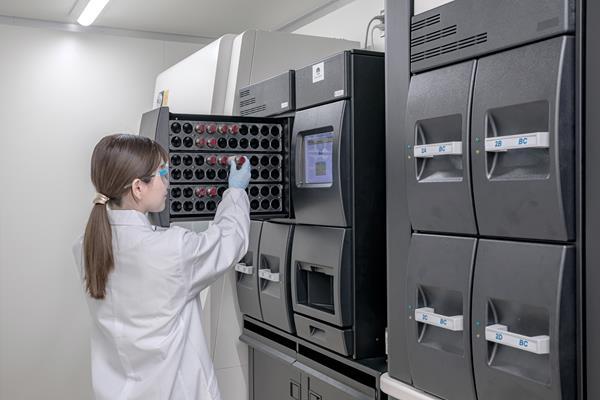
AGC Biologics Welcomes Multiple Cell Therapy Projects to New Yokohama Site
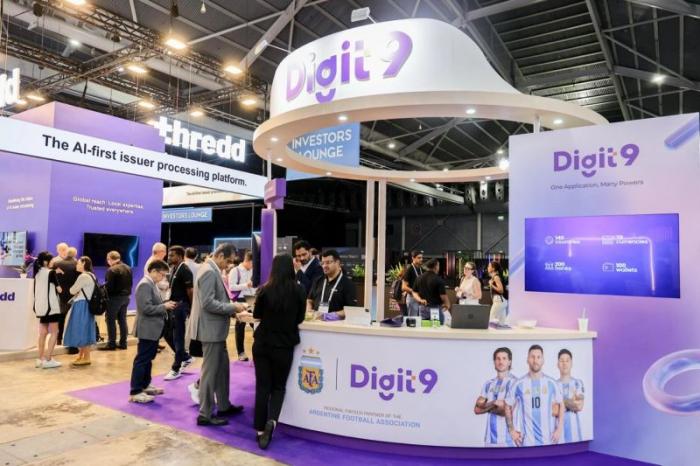
Digit9 selects Clear Junction to support international remittance growth
From Physics to Factory: NAED's PV-1 Delivers the Tandem Era at 96,000 WPH

Octave to Participate in Upcoming Investor Conferences

Infoblox Launches Australia Realm on AWS, Giving Regulated Organizations a Local Option for DDI Management and Preemptive Security

Broad AI Adoption Could Boost Latin America and Caribbean GDP by 5.1% Over a Decade, IDB Report Finds

EAACI calls for allergy and respiratory health to be part of climate action at COP31

From beekeeping in the Azores to Tokyo's toilet tour: GetYourGuide reveals its 2027 Hidden Trends no algorithm can predict

U.S. FDA Approves IGALMI as First At-Home Acute Treatment for Agitation Associated with Schizophrenia, Schizoaffective Disorder, or Bipolar I or II Disorder in Adults